
Pendulum
In this lab, we determine how the period of a pendulum (time for one full oscillation back and forth) depends on the length of the pendulum and how much the pendulum swings.Hoveroverthese!
Through these measurements and a theoretical formula that pendula should follow, we will calculate the value of \(g\), the acceleration due to gravity.
- 1 Pendulum Setup (Metal Bars, String, Steel Ball)
- 1 Protractor
- 1 Meter Stick
- 1 Stopwatch (feel free to use your phone, or just Google "stopwatch" and use the one that comes up)
- Record data in this Google Sheets data table
Although pendula come much later in the physics curriculum than the material you have covered so far,1 you almost assuredly have experience with a pendulum of some form from your everyday experience. They swing back and forth periodically, from some maximum angle to the opposite side and back again.
The simplest picture of a pendulum is called, appropriately, a simple pendulum. This consists of a very small mass hanging from a long essentially-massless string. The approximations we make are that the mass is much smaller than the length of the string and that the mass is much heavier than the string.
Under these approximations, a pendulum of length \(L\) (measured to the center of the hanging mass) looks as follows:

In this lab, we are interested in the period, \(T\), of the pendulum. This is the time it takes the pendulum to complete one full swing - from one side to the other and back again (or, equivalently, from the middle, up to one side, down past the middle and up the other side, and back down to the middle again).
When oscillations are small (i.e., the pendulum isn't swinging too much),1 we can make a small angle approximation which allows us to derive the following simple formula for the period of a simple pendulum of length \(L\) in a gravitational field of strength \(g\):
$$T=2\pi\sqrt{\frac{L}{g}}$$When oscillations are large, we expect the period to deviate from this simple formula.2
The above formula means that, for small oscillations, we expect an \(L\) vs. \(T^2\) plot to be approximately linear. The above equation can be put in the form:
$$L=\frac{g}{4\pi^2}T^2$$This means that we can fit the plot with an equation of the form:
$$L=AT^2$$If we do so, then note that the constant must be the same in both equations. This means that we can relate the slope of our plot to \(g\):
$$A=\frac{g}{4\pi^2}$$Or, written in a simpler form for our purposes:
$$g=4\pi^2 A$$Part I: Determining the Random Error in Time Measurements
Before we start measuring periods of oscillations and trying to validate the above formula, let's understand the uncertainty in our measurements.
While we can reasonably estimate an uncertainty in our length measurement, it's not immediately obvious how precisely we can measure the period of the pendulum.
The stopwatch on the computer measures to a hundredth of a second, but we should be careful: our measurements are hardly that precise. The dominant source of uncertainty here is from your hand, not the computer - and who knows what that uncertainty is? It probably varies from person to person! Thus, we have to measure it.
Set the length of the pendulum to 50cm or so.1 You don't have to be precise with the length yet; we're not concerned about the actual values.
Have one partner (Partner 1) hold the stopwatch, and the other partner (Partner 2) hold the pendulum up at a small angle from the vertical (say, \(15^\circ\) or so - again, no need to be precise yet).
Have Partner 2 release the pendulum and let it swing. After a swing or two, Partner 1 should hit the start button at the bottom of the swing.
Time how long it takes the pendulum to complete ten swings back and forth.23
Record the time to undergo ten swings in your data table as Trial 1. Repeat this procedure for four more trials.
Then, swap partner positions, and record five trials with the other partner timing.
Part II: Determining the Dependence of Period on Angle \(\theta\)
Now, we're going to do the same measurement - time for ten swings - for different angles. Leave the length as it is.
As before, have one partner man the stopwatch and the other measure the angle and start the swinging. (Remember who held the stopwatch - you'll want to use their uncertainty in period.)
Begin with a \(15^\circ\) angle from the vertical. Keep in mind how to properly use a protractor (measure the angle from the appropriate point).
Release (be careful to give it as little initial velocity as possible!), and measure ten periods. Record this on your data table.
Repeat for angles \(30^\circ\) and \(80^\circ\) from the vertical.
Part III: Determining the Dependence of Period on Pendulum Length \(L\) and Measuring \(g\)
Again, same measurement, just varying length this time.
Begin by setting the length to 10cm or so. Measure this length from the point where the pendulum swings (the top of the string) to the center of the ball (to the best of your ability to estimate the center of the ball).
Estimate your uncertainty in your measurement of this length. This requires some thought: what is your dominant uncertainty here?
At this length, measure ten periods at \(15^\circ\), same as before.
Repeat this measurement for lengths increasing to about 1m in increments of about 10cm, measuring the actual length L (which may not be exactly 10cm, 20cm, etc.!) with your meter stick each time.
Part I: Determining the Random Error in Time Measurements
For each partner, calculate the mean of all five measurements using formula (2) from the Guide to Uncertainty Propagation and Error Analysis.
Calculate the uncertainty in the mean of these measurements using error analysis formula (3) and the uncertainty of an individual measurements using error analysis formula (4).
Part II: Determining the Dependence of Period on Angle \(\theta\)
For each angle, take the uncertainty in \(10T\) to be the uncertainty in a single measurement you calculated in Part I (for the partner who actually timed this set of measurements).
Calculate the period \(T\) for each angle. Propagate uncertainty from \(10T\) to \(T\) using error analysis formula (7).
Part III: Determining the Dependence of Period on Pendulum Length \(L\) and Measuring \(g\)
Take the uncertainty in \(10T\) to be the uncertainty in a single measurement as from Part I, and calculate the period \(T\) and the uncertainty in \(T\) (just as you did for Part II).
Calculate \(T^2\) and \(L^2\). Propagate uncertainties from \(T\) and \(L\) into uncertainties in these quantities using error analysis formula (11).
Make three plots: one of \(L\) vs. \(T\), one of \(L^2\) vs. \(T\), and one of \(L\) vs. \(T^2\) using the PHY121/122 Plotting Tool. For each of these plots, you should include error bars on each axis (equal to your calculated uncertainties in the relevant quantities), good axis labels, and a good title. See the Guide to Making and Using Plots for more details.
Take the slope of the most linear graph, and enter it into your data table. From this slope, calculate \(g\), and propagate uncertainty from slope to \(g\).
(Keep in mind that the above formula relating \(A\) to \(g\) only works if you orient your axes correctly. Think: what equation are you fitting, and how does the slope of that plot relate to \(g\)? Ask your TA if you are confused by this point!)
Your TA will ask you to answer some of the following questions (they will tell you which ones to answer):
Experimental Questions:
- When you compare your partner's uncertainties, what are you determining about your measurements? Does the comparison tell you about random or systemic errors?
- What did you consider to be the dominant source of uncertainty when measuring \(L\)? Why did you pick the uncertainty that you did?
- Why might measuring the time at the bottom of the swing yield better precision than measuring at one end?3
Theoretical Questions:
- Why do we not use the \(30^\circ\) or \(80^\circ\) degree angles in Part III?
- We made an idealization that the string was massless. Suppose the string in fact had a significant mass. Would you expect the period to increase or decrease, and why? (Hint: you can qualitatively treat the mass of the string as reducing the "average" length of the pendulum.)
For Further Thought:
- The full general formula for the period of a pendulum of arbitrary amplitude is: $$T=T_0\times\frac{2}{\pi}K(\sin(\theta/2))$$ where \(T_0\) is the period from our small angle approximation, \(\theta\) is the maximum angle the pendulum swings, and \(K\) is a special function called the complete elliptic integral of the first kind.2 Using a program like Wolfram|Alpha,4 calculate the correction factor \(\frac{2}{\pi}K(\sin(\theta/2))\) for each of the angles you measure in part II.5 How big is the correction (i.e., how far is this number from 1)? Does the period get bigger or smaller for large angles? How does the theoretical deviation from expectation compare to your results in Part 2?
Hovering over these bubbles will make a footnote pop up. Gray footnotes are citations and links to outside references.
Blue footnotes are discussions of general physics material that would break up the flow of explanation to include directly. These can be important subtleties, advanced material, historical asides, hints for questions, etc.
Yellow footnotes are details about experimental procedure or analysis. These can be reminders about how to use equipment, explanations of how to get good results, troubleshooting tips, or clarifications on details of frequent confusion.
To read ahead in your textbook and get more detail, see KJF ch. 14.5.
For more details on this function, see here. For the derivation of this formula from first principles, see here.
To be more quantitative: we are approximating that \(\sin(\theta)\simeq\theta\), so the approximation we make is valid when that approximation is valid.
The general formula for the period of a pendulum for large oscillations is rather complicated. It involves elliptic integrals. You won't be learning it in this class.
Hint: what is the quantity we are measuring (for which we want to minimize uncertainty)? If the speed is higher, what does this do to our uncertainty in that quantity, and why?
Ideally, your setup should look like this:
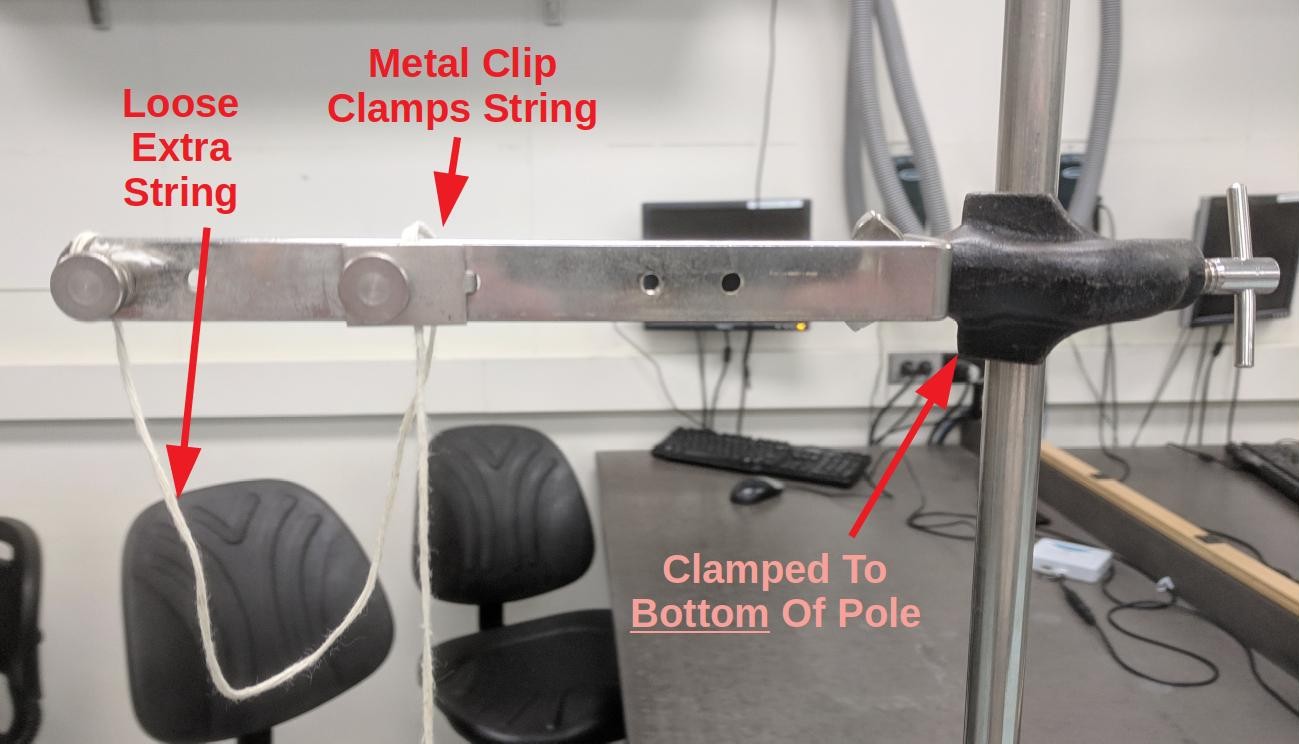
in which case you should be able to slide your string freely by loosinging the screw a bit, then clamp it at any height. If you are missing the metal clip, wind/unwind the rope around the screws to change length instead.
For optimal results, count when it is at the bottom of its swing. This maximizes your timing precision in determining the period. (If you don't believe this, feel free to test, and compare the uncertainty of the two methods yourself!)
A convenient way to count (to make sure that you don't end up making a mistake) is to, when you press the start button, say "zero." Then, as it swings back and forth past the bottom, count: "zero, and, one, and, two..." Then, stop when you say "ten."
You should just be able to enter "K" and the computer will understand what you mean; if not, try "EllipticK" instead.
Note Wolfram|Alpha assumes angles are entered in radians by default, although if you say "sin(90 degrees)" explicitly then it will give you the correct results.